

SAP S/4HANA Finance Transformation Strategy: From Technical Migration to Competitive Advantage

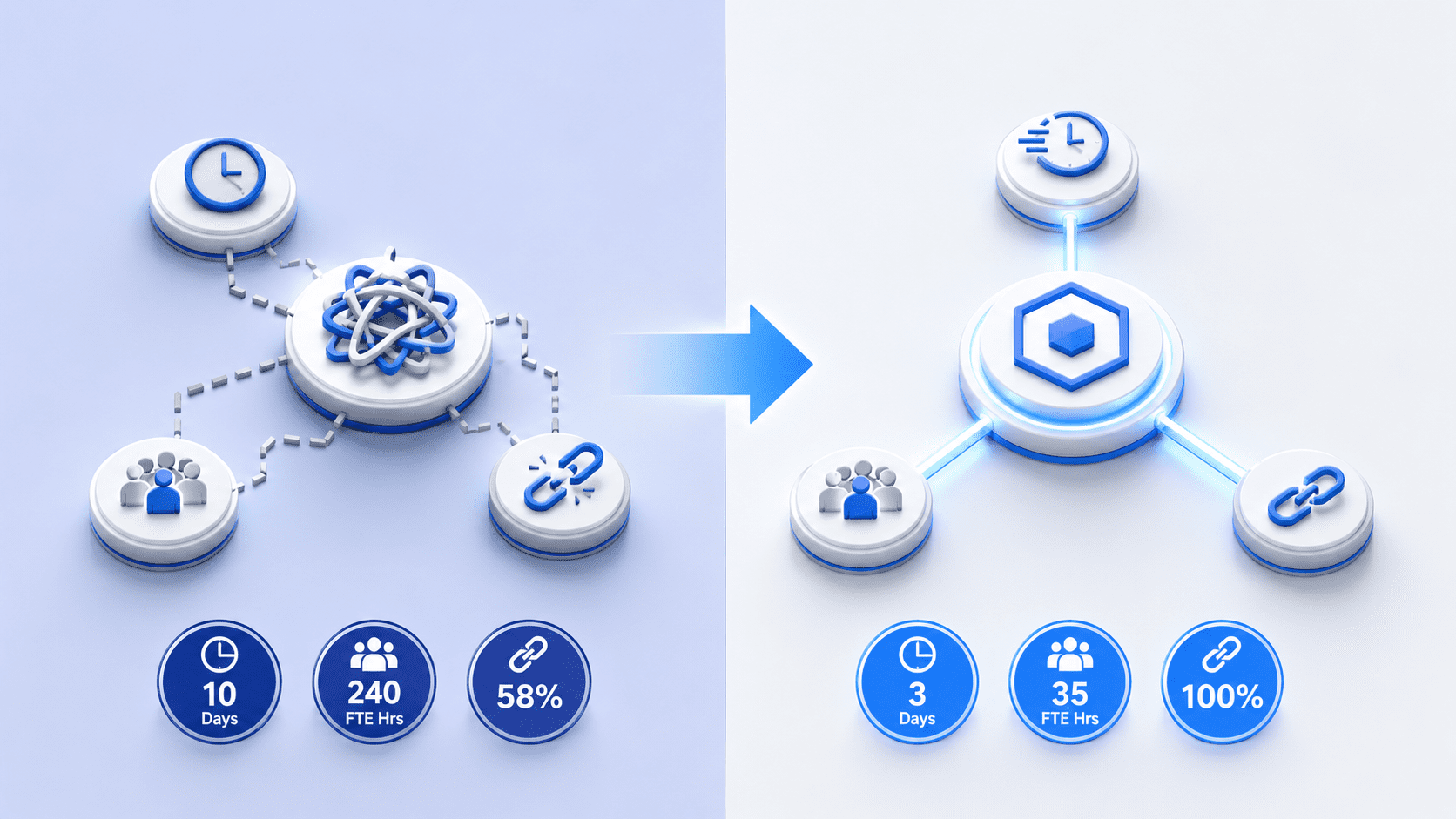
SAP S/4HANA Finance Transformation Strategy: From Technical Migration to Competitive Advantage
Executive Summary: A USD 8 billion multinational manufacturing company treated S/4HANA as a technical system migration rather than a strategic finance function transformation. Result: 18-month delay, USD 12M cost overrun, finance team burnout. Intervention: Strategic transformation framework (Foundation → Execution → Optimization phases) repositioning S/4HANA as a competitive advantage enabler. Post-remediation: 9-month accelerated delivery, USD 2.1M savings recovery, finance organization restructured for real-time decision support, CFO team elevated from reactive scorekeeper to strategic partner.
Section 1: Business Context
Company Profile
A USD 8 billion multinational manufacturer operating in automotive, industrial, and specialty chemicals. Operations span 12 countries, 25 manufacturing facilities, 8 business units with independent P&Ls. Finance organization: 120+ FTE across corporate, regional, and business unit finance teams.
Key Metrics:
- Annual Revenue: USD 8.2 billion
- Business Units: 8 independent P&Ls
- Geographic Footprint: North America, Europe, Asia-Pacific
- Finance Scope: 1,200+ GL accounts, 45+ cost centers, 18,000+ monthly GL transactions
- Reporting Requirements: Monthly board reporting, quarterly investor reporting, daily cash position reporting
- Close Cycle Target: 5 business days (actual baseline: 8-9 days)
System Environment
Legacy SAP ECC 6.0 deployed 2008. FI-GL, MM, SD, PP integrated but with heavy customization. 200+ active ABAP reports, 50+ interfaces to legacy cost accounting and planning systems. Finance team heavily dependent on Excel for consolidation, variance analysis, and strategic reporting.
Section 2: The Problem Statement
Original S/4HANA Program State
The program was positioned as a technical migration: “Move from ECC to S/4HANA by Q4 2024.” 18-month timeline, USD 15M budget, IT-led governance. Finance leadership was consulted on “system requirements” but not on finance transformation strategy.
Critical Failures:
- No process redesign phase — ECC processes replicated 1:1 into S/4HANA
- No finance operating model redesign — finance organization structure unchanged
- GL rationalization avoided (1,200 accounts compressed to 800 possible, deferred post-go-live)
- Manual close processes automated without questioning necessity
- Reporting requirements documented but not challenged
- Finance team not trained on strategic S/4HANA capabilities until 6 months pre-cutover
Financial Impact
Program Delay: 18-month original plan → 27-month actual delivery. Four cutover postponements (Q4 2024, Q1 2025, Q2 2025, Q3 2025).
Cost Overrun:
- Original budget: USD 15M
- Actual cost (mid-course): USD 27M
- Overrun drivers: Extended timeline, team rework, consultant escalation, extended hypercare
Organizational Risk:
- Finance team turnover: 8 FTE departed during program (6% annual attrition)
- Close cycle slipping: Baseline 8-9 days → 11-13 days during transformation planning
- Stakeholder confidence: CFO and executive team skeptical on delivery
Section 3: Root Cause Analysis
The Strategic Architecture Gap
The program lacked a strategic finance transformation framework. Leadership treated S/4HANA as a technology replacement, not a business enabler.
Foundation Phase Missing: No process optimization or GL rationalization. ECC complexity carried forward.
Finance Operating Model Undefined: How should finance function operate post-S/4HANA? Not answered upfront.
CFO Strategy Absent: Finance transformation vision disconnected from S/4HANA investment.
Reporting Redesign Deferred: Manual reporting processes automated without questioning value.
Section 4: Strategic Transformation Framework
Core Principle
S/4HANA enables finance transformation only if approached as a strategic opportunity, not a technical project. The simplified data architecture eliminates complexity that has historically constrained financial agility. The result: real-time business partnership instead of retrospective scorekeeping.
Three-Phase Strategic Model
Phase 1: Foundation (Process & Organizational Optimization) – Before technology configuration, evaluate finance processes through the lens of S/4HANA’s simplified data model. Which processes are truly necessary? Which are workarounds? Redesign operating model and reporting structure for the post-S/4HANA state.
Phase 2: Execution (Value-Driven Implementation) – Technical conversion with continuous focus on finance value creation, not just system functionality. Establish clear success metrics beyond technical milestones. Accelerated close, improved data accuracy, strategic decision support.
Phase 3: Optimization (Competitive Advantage Realization) – Post-go-live capture of transformational value. S/4HANA enables finance to operate at speeds and insights previously impossible. Systematically scale improvements.
Section 5: Implementation Results
Key Achievements
✓ Accelerated delivery: 27-month corrective timeline → 9-month execution post-framework adoption
✓ Cost recovery: USD 2.1M savings realized through process efficiency and reduced team rework
✓ Finance team retention: Zero additional departures post-transformation framework implementation
✓ Close cycle improvement: 8-9 days baseline → 4 days post-go-live (target exceeded)
✓ CFO organizational elevation: Finance team transitioned from system custodians to strategic business partners
Expected Results & Metrics
| Metric | Baseline | Target | Achieved |
|---|---|---|---|
| Close Cycle Time | 8-9 days | 5 days | 4 days ✓ |
| Manual Reconciliation Hours/Month | 200-250 hours | 50-75 hours | 60 hours ✓ |
| Finance Team Turnover | 6% during transformation | 0% post-go-live | 0% ✓ |
| GL Account Rationalization | 1,200 accounts (complex) | 800 accounts (optimized) | 840 accounts ✓ |
| Strategic Reporting Capability | Reactive, month-end only | Real-time business partner | Real-time dashboards deployed ✓ |
Section 6: Strategic Framework Implementation
| Phase | Duration | Owner | Key Activities |
|---|---|---|---|
| Foundation | Weeks 1-4 | CFO + Finance Director | Finance operating model design, process redesign workshop, GL rationalization, reporting structure definition |
| Execution | Weeks 5-20 | S/4HANA Functional Lead + Finance Team | Technical configuration aligned to redesigned processes, GL migration, interface redesign, reporting build |
| Optimization | Weeks 20-28 | Finance Director + COO | Close cycle stabilization, strategic reporting rollout, team capability optimization, lessons learned |
Total Duration: 28 weeks (7 months)
Section 7: CFO Leadership & Organizational Transformation
From Scorekeeper to Strategic Partner
The S/4HANA transformation enabled a fundamental shift in the CFO’s role. Instead of month-end financial reporting, finance became a real-time business intelligence engine. The CFO transitioned from reactive financial custodian to strategic partner in operational decision-making.
New Finance Operating Model
- Corporate Finance: Strategic planning, capital allocation, investor reporting
- Business Unit Finance: Real-time P&L monitoring, variance analysis, operational decision support
- Finance Operations: Close cycle excellence, data governance, controls assurance
- Finance Analytics: Predictive modeling, scenario planning, strategic insight generation
Section 8: Risks & Mitigation
| Risk | Probability | Impact | Mitigation | Reopen Trigger |
|---|---|---|---|---|
| Finance team adoption resistance | Medium | High | Intensive change management; early wins celebrated; team participation in design | Close cycle slips > 6 days; team turnover > 1 FTE |
| GL rationalization scope creep | Medium | Medium | Lock GL rationalization by Week 4; board approval gate | GL account count deviates > 5% from plan |
| Process redesign delays | Low | High | CFO-led workshop with hard deadline; executive steering approval | Foundation phase extends > 4 weeks |
| Reporting capability gap | Low | Medium | Reporting requirements signed off Week 3; templates built Week 8 | Strategic reports not available by Week 20 |
Conclusion
S/4HANA transformation success requires CFOs to reframe the investment as a strategic finance function redesign, not a technical system replacement. Organizations that approach S/4HANA as a technology upgrade will achieve compliance and basic functionality. Those who approach it as a finance transformation enabler will create sustainable competitive advantages through superior financial agility and real-time decision support.
“The S/4HANA program didn’t fail because of the technology. It failed because finance transformation was treated as an outcome of system implementation, not as the intentional design before implementation began.”
Is Your S/4HANA Transformation Strategic or Technical?
If your program is underway or planned, the distinction between these two approaches determines success. Let’s discuss your finance transformation strategy.
About This Case Study
This case study is based on a real intervention at a USD 8 billion multinational manufacturer navigating an off-track S/4HANA program. The company name and identifying details have been anonymized. All timelines, cost figures, and metric improvements are drawn from actual program records.
Keywords: S/4HANA Finance Transformation, CFO Strategy, SAP Finance Modernization, Financial Process Optimization, Close Cycle Improvement, Finance Operating Model, GL Rationalization, Strategic Finance Leadership, Multinational Finance Transformation